 Certified Services Partner
Airtable consulting, built like real software.
Whether you are on spreadsheets now or rebuilding a base that stalled. We handle the data structure, the automations, and the interfaces. Built once, properly.
Free 30-minute call. You leave knowing exactly what to build, whether you hire us or not.
$15k–$40k typical · Fixed price · 4 weeks to launch
Five parts, one system.
Sound familiar?
Airtable is easy to start. It's hard to build right.
Anyone can stand up a base in an afternoon. What breaks later is the part nobody sees up front: how the data is structured, what happens when two people edit at once, and whether it survives the person who built it.
If you already have a base
You started the build yourself and hit a wall on where it should go next.
The system throws errors you patch instead of fix.
It was built by a manager whose real job is running the work, not maintaining a database.
It runs, but you wouldn't build the rest of the business on top of it.
What we build
Full Airtable implementation, built to professional standard.
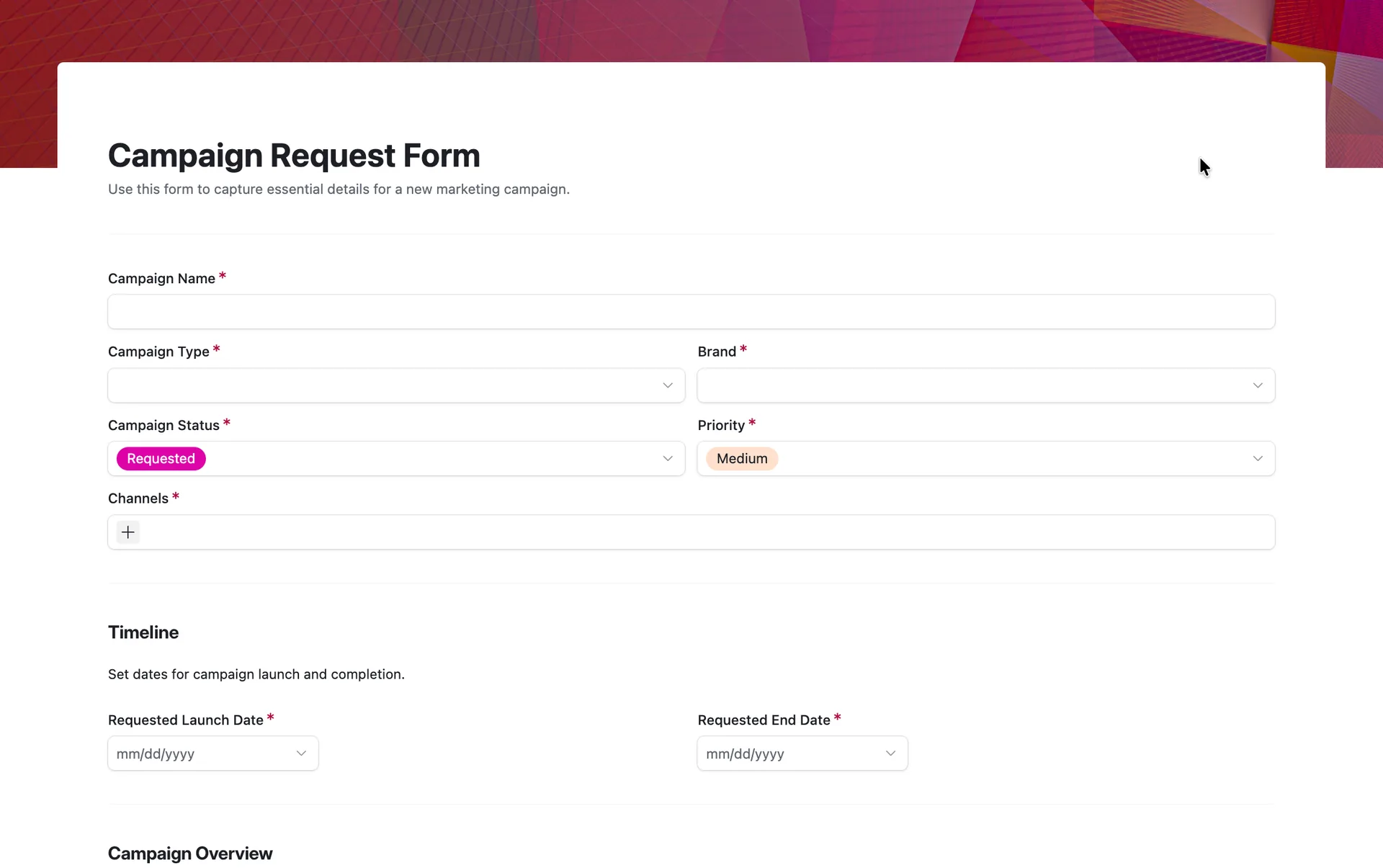
Forms & intake
Branded forms that write straight into the base with required fields, conditional logic, and the right record links already made. No re-keying, no chasing someone for the brand or the launch date.
Conditional fieldsRequired validationAuto-linkingBranded
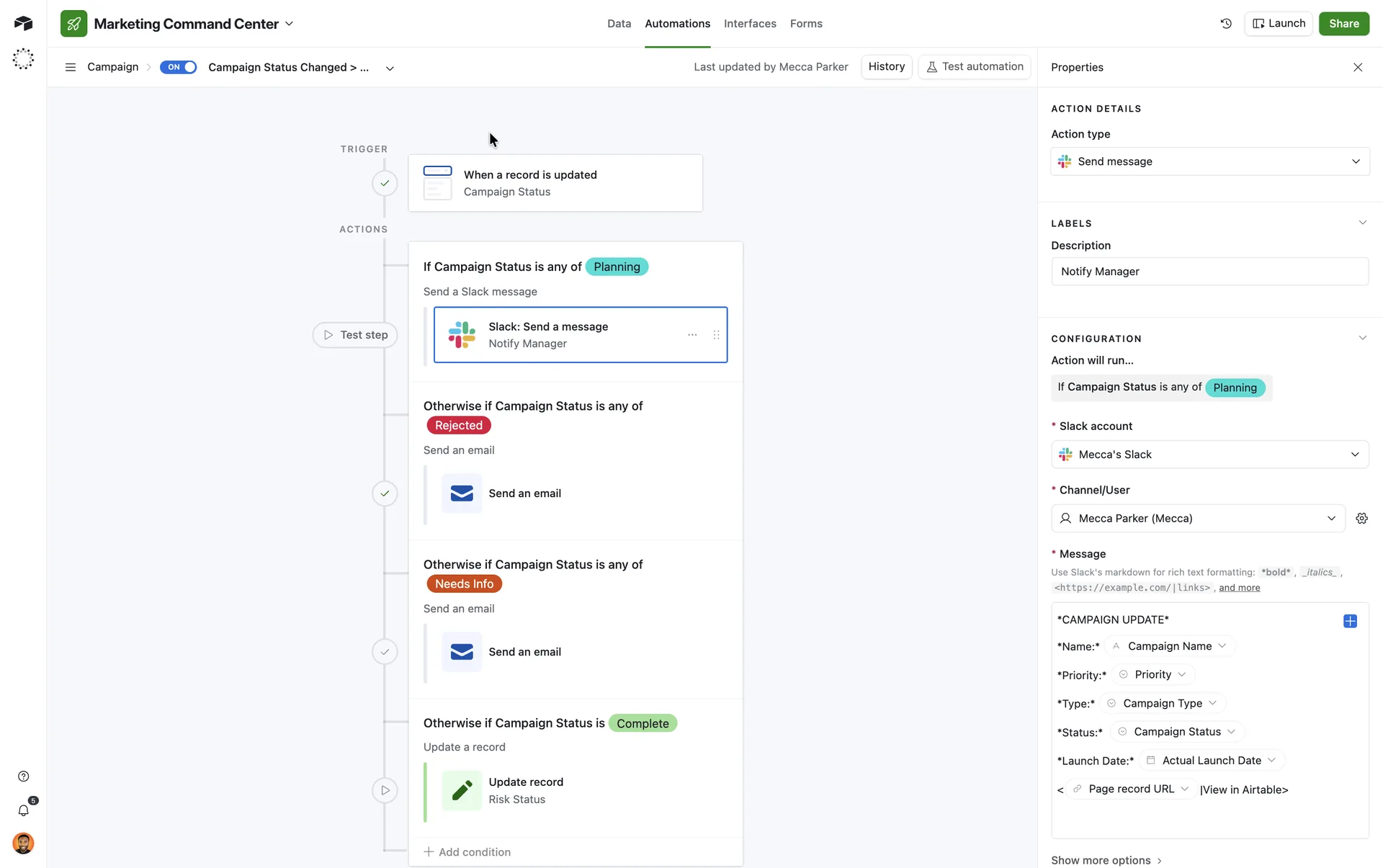
Automations & integration
Status changes route themselves, and the systems either side of Airtable stay in step: HubSpot, Salesforce, Slack, Make, Zapier, custom APIs. One record updated once, everywhere it needs to be. The reliable version of the automations you patched together.
HubSpot · SalesforceMake · ZapierCustom APIsError handling
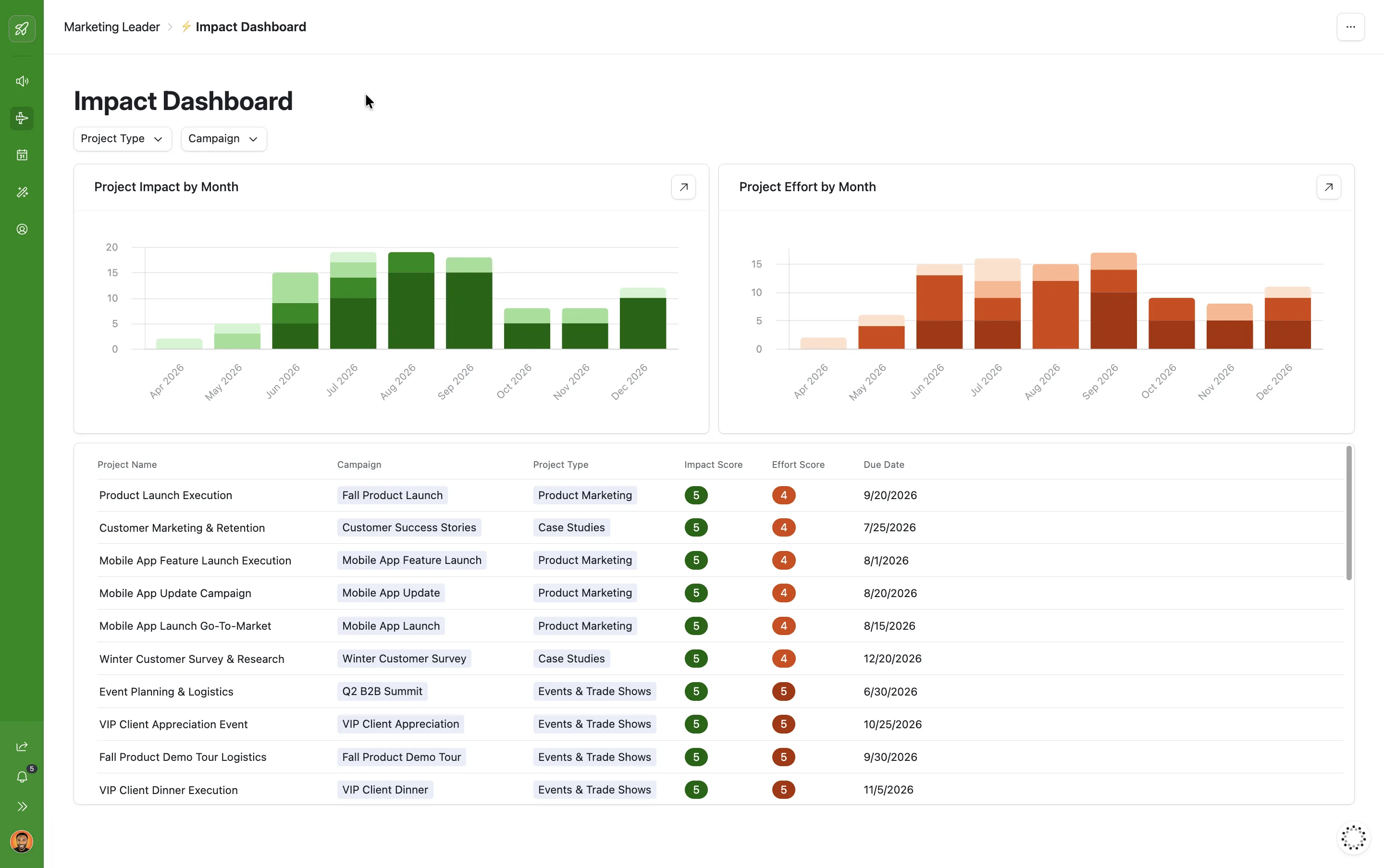
Interfaces & dashboards
Live data, filtered to the person looking at it. Executives see the totals and what's off track; managers see their own queue; nobody gets a spreadsheet export. Built for the people who make decisions.
Role-based viewsLive chartsFiltered recordsDrill-through
Which projects are at risk this month?
Projects · filter: Health ≠ On track
Four are flagged. The inventory sync is the one to look at first: burn rate is the only issue here a conversation cannot fix.
Flag the portal rebuild and set a follow-up.
✓ Updated 1 record · Created 1 record
Artificial intelligence
The reading and sorting a person does before the real work starts. Inbound messages and documents classified against your own records, routed to the right owner, and drafted for review rather than written from scratch.
ClassificationExtractionDrafted responsesHuman review
Client reviews
Clients we've worked with.
62
Builds completed
20
Industries served
5.0
Average rating
“Park West has been an excellent partner throughout this program and has been the driving force the design and delivery of highly customized solutions for one of the largest social impact organizations in the U.S.”

Jack Hanley
Urban Data Strategies
“I was astounded by the team’s ability to take our complicated direction and translate it into a system that was user-friendly, dynamic and intuitive. It’s been a complete game changer for our team.”

Cara Hays
The Kraft Heinz Company
“Park West Digital exceeded our expectations. They worked hard to understand our specific needs and tailor their work accordingly — meeting cadence, the platform they communicated on, the format of the SOPs they delivered.”
Makaela Kingsley
Dream Machine Innovation Lab
“They delivered beyond expectations and even anticipated our need to scale quickly. The app they built became critical to our company’s operations.”

Erica Lawrence
3E Project Solutions
“Park West Digital is a godsend for small business seeking quality expertise in implementing tech solutions. Mecca is professional, thorough, and extremely talented.”

Dan
Grassroots Grocery
“It’s rare to find people that care this much about their work these days. I can’t recommend them enough!”

Monte White
Ski Trucks
“They are professional, reliable and highly skilled, and have gone above and beyond the scope of their responsibilities to ensure we were satisfied. Exceptional work!”

Allison
Fintech Islands
“They went above and beyond to make sure they understood how our business operates — then developed a solution that allows us to easily track customers, inventory, costs.”

Dionne Parker
Kuhalisi
“Park West Digital has gone above and beyond to work with us, especially as our project has evolved, to ensure we get what we need from the system we’re working with.”

Ethan Lipsitz
EXODUS Leadership Forum
Who you work with

Mecca Parker
- Founder, Park West Digital
- Carnegie Mellon engineer
- Accenture consultant
- Airtable Certified
- Fortune 500 clients
Certified Airtable Services Partner and senior Airtable specialist. Fourteen years building operational systems.
Most Airtable systems are built by someone capable who's doing it alongside a full-time job. That's precisely why they break. Park West Digital builds Airtable systems as its full-time discipline, combining the rigor of an engineer with the judgment of a consultant, so the system your business depends on performs like it should.
Case studies
The same system, in other operations.
Real builds, named clients, and the numbers we were able to clear for publication.
Questions
Common questions about hiring an Airtable consultant.
What does an Airtable consultant actually do?
An Airtable consultant designs, builds, and rebuilds Airtable systems for teams that have outgrown spreadsheets or their own internal build. That includes data architecture, automations, interfaces, dashboards, forms, and integrations, all built to a professional standard your team can rely on.
What do your Airtable consulting services include?
Data architecture, automations, interfaces and dashboards, forms, and integrations with the rest of your stack, designed together rather than bolted on afterwards. Every engagement runs the same four stages: an audit of how the work moves today, an architecture you approve before anything is built, a staged build you review weekly, and a handover with documentation and training.
Do I need an Airtable expert, or can my team learn this?
Your team can learn Airtable, and after a build they run it. Every system is handed over documented and trained, because depending on us is a design failure rather than a business model. What a specialist brings is the part that is expensive to learn on live data: the schema decisions, permissions, and automation logic that cost nothing to change in week one and a rebuild to change once the system is in use.
How much does an Airtable implementation cost?
Most full builds land between $15,000 and $40,000, depending on how many teams the system serves and how much data has to come across. After a free consultation you get a fixed price and a fixed timeline for your scope, so there's no ambiguity before you commit.
How long does an Airtable build take?
A full build runs four weeks from blueprint to handover: one week of blueprint, two building, one handing over. First builds and rebuilds follow the same schedule. Smaller scopes finish sooner; the timeline is fixed before anything starts.
Do you only work on existing bases, or can you build from scratch?
Both. Roughly half our Airtable work is a first build for a team coming off spreadsheets; the other half is rebuilding something started internally that hit a wall. On a rebuild we audit what you have, keep what works, and replace what doesn't scale.
Do you work with nonprofits?
Yes. We build Airtable systems for mission-driven organizations alongside operations and marketing teams, including grant tracking, program data, and impact reporting. See how we did it for a national civic organization and a volunteer-run food justice org.
What integrations do you support?
We connect Airtable to HubSpot, Salesforce, Slack, Make, Zapier, custom APIs, AI tools, and more, so your Airtable system works with the rest of your stack instead of sitting beside it.
Are you a certified Airtable consultant?
Yes. Park West Digital is a certified Airtable Services Partner, with work spanning Fortune 500 teams and national organizations.
Start here
Talk to an Airtable consultant.
Book a free 30-minute consultation. We look at what you have, tell you what's holding it back, and are honest about whether we're the right fit.
Pick a time and we’ll be there.